
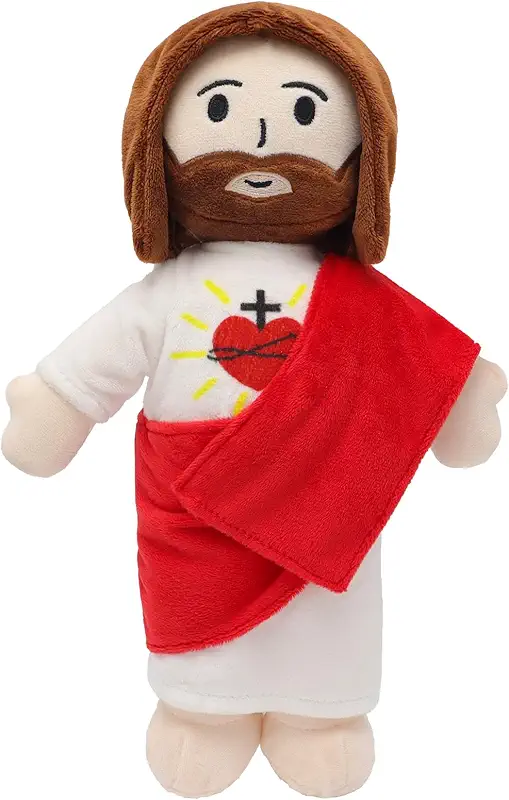
What a Plush Jesus Doll Really Is in Everyday Faith
When people talk about a Plush Jesus doll, it can sound like a simple toy. But in many Catholic homes, it quietly becomes something more: a soft reminder that faith is part of ordinary life, even in the playroom, the stroller, or bedtime routines.
Children learn about God first through what they can see and touch. A gentle, friendly-looking Jesus doll gives them a way to hold onto something that points beyond itself. It is not a sacred object in itself, and it is certainly not a replacement for prayer, the Bible, or the sacraments. It is simply a companion that can help turn small moments into opportunities to remember the Lord with affection and simplicity.
In my own home, the first time we brought a soft Jesus doll into the kids’ room, I did not plan anything special. It just sat on a little shelf near some picture books and a children’s Bible. Over time, I noticed that when my younger child was worried or overtired, she would quietly reach for that doll along with her blanket. It became part of a sense of safety and peace connected to prayer, bedtimes, and family blessings.
A plush figure can make Jesus feel less distant to a child who is still learning words and ideas. They might hug Him, talk to Him, or bring the doll to the table when you read a Bible story. None of this needs to be forced or overly planned. It can stay gentle and natural, like any other part of family life.
How a Plush Jesus Doll Fits Into Catholic Family Life
In American Catholic homes, faith often finds its place in small, repeated routines: a quick sign of the cross before school, grace before meals, a short prayer before bed. A Plush Jesus doll can quietly join those moments without turning them into a performance or a lesson.
Here are some simple ways families tend to use a soft Jesus doll in daily life:
- Keeping it on the bed or crib as a reminder of God’s love at night.
- Letting little ones hold it during family prayer or Bible stories.
- Placing it near a children’s prayer corner with a small cross or holy cards.
- Bringing it along for long car rides or visits, especially when routines are disrupted.
- Using it gently during conversations about fear, sadness, or forgiveness.
None of these uses make the doll something magical. It remains fabric and stuffing. The important part is the intention behind it: offering children something soft and familiar that points them toward the Lord in an age-appropriate way.
I remember one evening when my son had trouble sleeping after a tough day at school. He was curled up with his Plush Jesus doll, and instead of trying to lecture him about trust or courage, I just sat down and said, “Do you want to tell Jesus about your day?” He nodded and, in very simple words, talked about what bothered him. The doll simply gave him something to hold while his heart slowly opened in a quiet, childlike prayer.
As parents or grandparents, we cannot protect children from every fear or hurt. But we can give them tools and habits that gently lead them back to God in those moments. A plush doll is one small piece of that larger picture.
Design Details That Matter for a Jesus Plush
When choosing a Plush Jesus doll, some families look mainly at style or cuteness. Those things are fine, but there are also deeper questions that quietly matter, especially in a Catholic context.
Many parents pay attention to:
- Facial expression: A gentle, peaceful face can help children associate the Lord with calmness and kindness.
- Modest clothing: Simple robes in soft colors tend to feel more respectful and closer to traditional images.
- Durable stitching: Kids hug, drag, and drop their favorite toys; strong seams help the doll remain a steady presence over time.
- Soft materials: A comfortable texture invites children to hold the doll during prayer or bedtime.
- Washability: Being able to clean the doll when life gets messy keeps it from becoming something “too special to touch.”
I personally prefer when a Jesus doll looks humble and approachable. Not over-decorated, not dramatic, just simple. That simplicity keeps the focus on the quiet meaning behind it: a reminder of Someone who is close to us in ordinary life.
Some families also like dolls that reflect traditional Christian art in a respectful way, linking what their children see in church or in pictures to what they hold at home. Others prefer a more warmly stylized version. Either way, it can help to pause and ask: “Does this look like someone my child could trust and feel safe with?”
Prayer, Storytime, and Gentle Rituals With a Plush Jesus Doll
Children often learn through repetition and little rituals. A Plush Jesus doll can quietly anchor some of those habits without turning them into something rigid. Everything can stay simple, light, and suited to the child’s age.
Some ideas families often find helpful:
- Bedtime blessing: Hold the doll together, make the sign of the cross on your child’s forehead, and say a short prayer in your own words.
- Storytime companion: Place the doll next to you when you read a children’s Bible story. Sometimes kids will naturally talk to Jesus afterward.
- Thankful moments: Before dinner, let younger kids hold the doll while naming one thing they are grateful for that day.
- Tough days: When a child is upset, simply invite them—if they want—to hold Jesus and talk to Him quietly about what happened.
- Feast days: Bring the doll to the table or prayer corner on major feasts to mark the day in a way children can see.
One small habit that grew in our home was placing the Plush Jesus doll on a little shelf during Advent, near the nativity scene but not in the manger. Every Sunday we would move Him a bit closer, and the kids would remember that we were getting closer to Christmas together. It was simple, but it helped them feel the season in a way they could understand.
These kinds of practices do not need to be perfect. Some nights will be rushed, some prayers distracted, some dolls left on the floor. That is normal family life. The important part is the overall atmosphere the child slowly absorbs: that Jesus is near, gentle, and present in the ordinary mess.
Respect, Reverence, and Healthy Boundaries
Because we care about treating holy things with respect, some people wonder whether a Plush Jesus doll is appropriate at all. It is a good question to ask. The Church teaches us to honor the Lord in our hearts, our words, and our surroundings, and Catholic parents naturally carry that concern into the nursery and playroom.
One helpful distinction is to remember that a plush doll is not a blessed object by default, and it is not a sacramental unless specifically blessed for that purpose. It is basically a toy that points toward a deeper reality. That means ordinary wear and tear is not disrespectful, as long as we keep a basic sense of care and modesty.
In our family, we set a few gentle boundaries that our kids understood with time:
- The Jesus doll does not get thrown around in anger or used in rough pretend battles.
- We keep it away from bathroom floors or other obviously dirty places.
- We remind the children that, while it is soft and huggable, it represents Someone real whom we talk to in prayer.
These guidelines were never shouted or enforced with fear. They were just quiet reminders that helped our children connect love for the Lord with how they treated the doll. Over time, they started to handle it more carefully on their own, without being told.
If a doll does become too worn out or damaged to keep, it can be thrown away respectfully, perhaps wrapped in a bag or cloth. Since it is not sacred in itself, there is no special ritual required, though some families like to say a short prayer of thanks for the good moments of faith it quietly supported.
Personal Experiences With a Plush Jesus Doll
Over the years, I have seen a Plush Jesus doll play different roles in different seasons of family life. When our children were very small, it was almost entirely a comfort object. They did not yet understand much about the Lord, but they sensed something steady and kind connected to that figure.
As they grew older, the same doll slowly became more connected to conversations about who Jesus is. When we read Scripture stories—especially from the Gospels—they would often bring the doll into their lap. It was almost as if they were saying, “I want Him here while I listen.”
I remember a quiet afternoon when one of my kids, probably five or six at the time, was sick on the couch. The Plush Jesus doll was tucked under their arm. In a tired voice they asked, “Does Jesus stay with me even when I feel this bad?” That question did not come from a book or a homily; it came from the living link between the doll, their own feelings, and the simple faith growing in their heart.
Another time, visiting relatives who are not very familiar with Catholic practices, the doll actually opened a gentle conversation. A cousin asked, half-curious and half-confused, “Why do you guys have a Jesus stuffed animal?” It allowed us to share, in plain words, that we want our kids to feel that the Lord is part of our real life, not just something in church on Sundays.
None of these experiences were dramatic or miraculous. They were small, everyday moments in which a Plush Jesus doll quietly helped keep the Lord present in our family’s rhythm. That is often how faith grows: slowly, steadily, through simple, ordinary things.
Helping Children Meet the Real Jesus
A soft doll is only one doorway among many that can help children become more aware of the real Jesus we meet in Scripture, the sacraments, and prayer. It is helpful to make sure the doll points beyond itself, not to itself.
For example, when a child is holding the doll, you might read from a children’s Bible and say, “This is the same Jesus we’re reading about.” You could also gently connect it to images in church: “He looks a little like the Jesus in the stained-glass window, doesn’t He?”
Many parents find it useful to introduce basic stories from the life of Christ: His birth, His kindness toward children, His healing of the sick, His death and resurrection. Reading these stories with the doll nearby can help them slowly realize that He is not just a character, but a living Person who knows them.
If you want to ground your family’s understanding, you can also look at a short, simple article about Jesus of Nazareth together when the children are older. Even a brief overview can deepen the context around the stories they already know.
Over time, the goal is that the child’s trust is not in the doll, but in the Lord Himself. The doll is just a stepping stone, an early language of fabric and color that slowly gives way to words, Scripture, and mature prayer.